Post New Topic

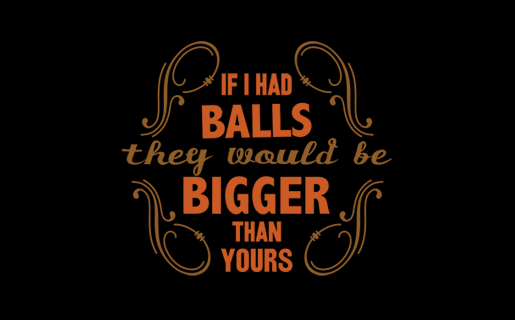
I want this shirt!!!!

JanuaryBride06 Posted:

I want this shirt!!!!

BJandDan Posted:

Re: I want this shirt!!!!

PRICELESS!!!!!!!!! I'd get it!!!! (And wear it proudly of course!!!!)

JanuaryBride06 Posted:

Re: I want this shirt!!!!

It's at tshirthell.com. I'm really tempted!
MayBride06 Posted:

Re: I want this shirt!!!!

Do it!!!
kris15198 Posted:

Re: I want this shirt!!!!

snydl40 Posted:

Re: I want this shirt!!!!

Soon2BeMrs2006 Posted:

Re: I want this shirt!!!!

iamvocal72 Posted:

Re: I want this shirt!!!!

I do have balls! My ovaries are my balls and they are SO BIGGER than yours! This is some information from Dr. Northup. She is SO COOL!


Ovaries

Anatomy

Ovaries are the small, oblong, pearl-colored organs that lie just below the fallopian tubes on each side of the uterus. Ovaries produce ripe eggs about once a month, from about age 14 or 15 onward. As the egg develops each month, a nourishing fluid-filled sac forms around it, so that it is encapsulated or walled off from the rest of the ovary. This fluid-filled area, known as a cyst, is physiologically completely normal, a fact that many women don’t appreciate. At ovulation, when the egg is released and picked up by the fallopian tube, the cyst actually bursts as part of the ovulatory process, and the surrounding fluid is released into the pelvic cavity along with the egg.

After ovulation, in the space where the egg used to be, a second small cystic area known as the corpus luteum develops and begins to secrete progesterone. The corpus luteum eventually gets reabsorbed by the ovary. Frequently the process of egg development begins and a small cyst forms, but ovulation doesn’t occur at that particular site. In this case, a small cyst will be left in that area of the ovary for a while. Because of this monthly process of egg development and cyst formation, it is perfectly normal for a woman to have small fluid-filled ovarian cysts at almost any time throughout her reproductive life. In fact, ovaries nearly always have small cysts in them.

Whenever a woman gets a pelvic ultrasound for chronic pelvic pain, a fibroid, or for any other reason, her ovaries are also scanned and these cysts show. Small 1–3-cm cysts are usually normal, because producing small physiological cysts that come and go is part of what normal ovaries do. They gestate little eggs, little cyst — or in energy medicine terms, young ideas ripe with potential.

Ovaries also produce hormones — including estrogen, progesterone and androgens — throughout the life-cycle, though the amounts they produce change (not necessarily declining), depending upon a woman’s age. It has been commonly thought that ovaries become essentially nonfunctional after a woman stops having periods, but studies in healthy women have proven that ovaries maintain their ability to produce steroid hormones for several decades after menopause. (See Reference 1, link below.) Parts of the ovaries do start to decrease in size when a woman is in her thirties, and they do lose mass more rapidly after age 45 on average, but they are not the inert fibrous tissue masses they’ve been thought to be.

As women age, only the outermost covering (theca) of the ovary regresses, the part where the eggs grow and develop and where physiological (“functional”) cysts form. In midlife, the innermost part of the ovary (inner stroma) becomes quite active for the first time in our lives (see Reference 2, link below). Studies have shown that our ovaries can produce androgens, as well as progesterone and estradiol, long after menopause. These hormones are significant in preventing osteoporosis and also maintaining energy and libido. (See Reference 3, link below).


Our Cultural Inheritance

Up until fairly recently, menopause has been studied mostly as a “deficiency disease.” Because of this cultural attitude, scientists have studied this natural process only to find out what is lacking. If we were to design studies of postmenopausal women in which the ovary was viewed as active and useful, we would probably find out more and more about the ovary’s role in maintaining normal balance in our bodies as time goes on. Our ovaries should be appreciated as dynamic organs that are part of our body’s wisdom throughout life, not as something useful or potentially harmful to us when we are over 40!


Energy Anatomy — Emotional Patterns Associated with Ovarian Problems

From an energy medicine standpoint, ovaries are the female equivalent of male testicles. They can be thought of as “female balls” because they represent exactly the same thing in the world. Our ovarian wisdom represents our deepest creativity, that which waits to be born from within us, that which can be born only through us, our unique creative potential — especially as it relates to what we create in the world outside of ourselves. To maintain health, a woman needs to understand how to use her “balls” in a life-enhancing way.

All the creations that come from deep within us, from our ovarian wisdom — whether they be babies, books, or works of art — have a life of their own that we have a responsibility to initiate and allow, but ultimately not control. Our ability to yield to our creativity, to acknowledge that we cannot control it with our intellect, is the key to understanding ovarian power. We must allow this power to come through us.

When a woman does not heed her innermost creative wisdom because of her fears or insecurities about the world outside of herself, ovarian problems can arise. They may arise in situations in which she perceives herself as being controlled by or criticized by forces outside herself. Financial or physical threats in the outer world affect the ovaries, particularly if a woman believes that she has no way to alleviate the threats. Thus, a woman who is abandoned by her mate or feels stressed on the job may develop ovarian problems if she feels that she has no means of escape from her situation and that the “outer” world is preventing her from changing.

Ovarian problems can result from a woman’s perception that people and circumstances outside of herself are preventing her from being creative. In addition, the energy of vengeance or the desire to get even may also adversely affect the ovaries.


Caring for Your Uterus and Ovaries, or Pelvic Space

* Know that the inherent creativity symbolized by your ovaries is always present for you, regardless of whether they are still physically present in your body.

* Make time each day to do something of creative value that has meaning for you. Let it come through you.

* Ask yourself the following questions:

Is there a creative endeavor that makes time stand still for you? Is there some activity or process in which you can immerse yourself and forget to eat? What is it?

Do any of your past creations have a life of their own? Can you celebrate being the woman who gave birth to them and then let them go? Are you still hanging on and trying to control anything you've created?

* Your creative power is sorely needed in the outer world now. This power can serve you and others very well when you access it fully and don’t try to control or force it. Acknowledge your ovarian power — your female balls.
mtdr1106 Posted:

Re: I want this shirt!!!!

love it!!
Soon2bMrsI Posted:

Re: I want this shirt!!!!

I DEFINATELY NEED ONE OF THESE!!!

susdoug Posted:

Re: I want this shirt!!!!

Danigrl28 Posted:

Re: I want this shirt!!!!

love it

SweetCin704 Posted:

Re: I want this shirt!!!!

that's classic Mel

Keywi231 Posted:

Re: I want this shirt!!!!

Marly Posted:

Re: I want this shirt!!!!

I LOVE IT!!!!!!!
KD1279 Posted:

Re: I want this shirt!!!!

suzzi7404 Posted:

Re: I want this shirt!!!!

Buy it it's awesome!

ruzi777 Posted:

Re: I want this shirt!!!!

I LOVE IT!!!!!
I would wear it!!!!!
Us Girls, do have bigger ones than guys do!!!!
Come on now.

jenafee Posted:

Re: I want this shirt!!!!

Hilarous!
AllJoy Posted:

Re: I want this shirt!!!!

Reply to this topic

Log in to reply or quote a post.