Does anyone have any samples of Jewish Wedding programs? Ideas? Thoughts?
Thank you in advance!
FallBride05
Posted:
Member since
Re: Jewish Wedding Programs
I do! We had a traditional orthodox ceremony, I have an explanation of everything anyone needs to know in my program,
You have FM
stephanielyse
Posted:
Member since
Re: Jewish Wedding Programs
I do! I no longer have the file saved on my computer, but I just found a copy of the program while cleaning this morning!
As a template I used programs from weddings I'd been to, one from an LIW bride and info from 'The New Jewish Wedding' book.
The Wedding Party Rabbi (name) Chuppah Holders (their names) Bridesmaids and Groomsmen (names in order) Maid of Honor and Best Man (names) The Groom (his name) Escorted by his parents (their names) The Bride (my name) Escorted by her parents (their names)
The Wedding Ceremony The Jewish wedding ceremony is rich with tradition and represents the joining of two lives, two hearts, two souls and two families. It is a time of great rejoicing and happiness.
The Ketubah Prior to the ceremony, Stephanie and Michael, along with their witnesses **** and ****, signed the ketubah, the Jewish marriage contract. It states Stephanie's rights and Michael's duties to her as her husband and has the standing of a legally binding agreement.
The Bedeken The bedeken is the veiling of the bride by the groom. The word bedeken comes from the word 'to check.' In the biblical story of Isaac and Rebecca, Rebecca veiled herself as a symbol of modesty upon seeing Isaac for the first time. The Torah also recalls the predicament of Jacob, who mistakenly believed he was marrying Rachel only to discover later that he had married her sister, Leah. It is, therefore, Jewish custom for the groom to veil the bride before the ceremony. Michael lowered the veil over Stephanie's face to set her apart from all others and to ensure that he will marry the woman he loves.
The Chuppah The chuppah is the wedding canopy under which Stephanie and Michael stand during the wedding ceremony. it represents the home they will build together as husband and wide. The structure is open on all sides so that family and friends will always be welcome. On the front of this chuppah are the Hebrew words 'Dodi Li V' Ani Lo,' or 'I am my beloved's and my beloved is mine.' When Stephanie reaches the chuppah, she will circle Michael three times. Circling is a magical means of protection. By walking around the groom the bride creates an invisible wall to protect him from evil spirits, from the glances of other women and from the temptations of the world. The three circles are based on the repetition from the Bible: 'And I will betroth you to me forever. I will betroth you to me in righetousness, and in justice, and in loving-kindness, and in compassion; and I will betroth you to me in faithfulness' (Hosea 2:19).
Kidushin The Jewish wedding is called Kiddushin, meaning sanctification, related to the word Kadosh (Holy). The Kiddushin is composed of two distinct ceremonies: Erusin (Bethrothal) and Nissuin (Nuptuals)
Erusin A blessing will be recited over a cup of wine, symbolizing join and divine sanctification of marriage. After the blessing, the bride and groom share the wine to symbolize a new, shared life.
The Rings In Jewish law a verbal declaration of marriage is not legally binding in and of itself. There must also be an act of kinyan - a formal, physical acquisition. Without the groom's giving and the bride's acceptance of some object of nomincal value - something shaveh p'trutah, literally, 'worth a penny' - there is no marriage. Ever since the seventh centry, a ring has been the traditional and preferred object of exchange. According to Jewish law, the ring must be unpierced and free of precious stones to avoid any possible misrepresentation of its value. A band made of single pure metal, with no holes breaking the circle, represents the wholeness achieved through marriage and a hope for an unbroken union.
Nissuin Rabbi **** will read the ketubah and explain its meaning. He will the present it to Stephanie for safekeeping.
Shevah B'rachot The shevah b'rachot, seven blessings, will be read in English by seven close family memebers and chanted in Hebrew by Rabbi ****. The blessings thank G-d for various elements of life, including the creation of the world and humanity, the couple's happiness, and love, harmony and peace in the couple's new life together.
Stephanie and Michael will then drink from the cup of wine a second time.
The Breaking of the Glass The wedding ceremony concludes when Michael steps on a glass and breaks it. The broken glass reminds us that as strong as love is, it is also fragile. It serves as a reminder of the sanctity of marriage and the destruction of the holy temple in Jerusalem. It also helps us to remember that even in times of great joy, we cannot forget the suffering of our people and all humankind. It is traditional to shoult 'Mazel Tov' at this time.
Yichud: Seclusion Immediately following the ceremony, Stephanie and Michael will retreat to a private room where they will share their first few moments togheter as husband and wife and absorb the events of the ceremony. Yichud is a period of bonding, privacy and peace before the public celebration begins. Stephanie and Michael will break bread alone and together for the first time as a married couple.
marcandjoanna
Posted:
Member since
Re: Jewish Wedding Programs
thank you! Any help would be appreciated - I was not sure which things to explain, which to leave off...
marcandjoanna
Posted:
Member since
Re: Jewish Wedding Programs
Posted by stephanielyse
I do! I no longer have the file saved on my computer, but I just found a copy of the program while cleaning this morning!
As a template I used programs from weddings I'd been to, one from an LIW bride and info from 'The New Jewish Wedding' book.
The Wedding Party Rabbi (name) Chuppah Holders (their names) Bridesmaids and Groomsmen (names in order) Maid of Honor and Best Man (names) The Groom (his name) Escorted by his parents (their names) The Bride (my name) Escorted by her parents (their names)
The Wedding Ceremony The Jewish wedding ceremony is rich with tradition and represents the joining of two lives, two hearts, two souls and two families. It is a time of great rejoicing and happiness.
The Ketubah Prior to the ceremony, Stephanie and Michael, along with their witnesses **** and ****, signed the ketubah, the Jewish marriage contract. It states Stephanie's rights and Michael's duties to her as her husband and has the standing of a legally binding agreement.
The Bedeken The bedeken is the veiling of the bride by the groom. The word bedeken comes from the word 'to check.' In the biblical story of Isaac and Rebecca, Rebecca veiled herself as a symbol of modesty upon seeing Isaac for the first time. The Torah also recalls the predicament of Jacob, who mistakenly believed he was marrying Rachel only to discover later that he had married her sister, Leah. It is, therefore, Jewish custom for the groom to veil the bride before the ceremony. Michael lowered the veil over Stephanie's face to set her apart from all others and to ensure that he will marry the woman he loves.
The Chuppah The chuppah is the wedding canopy under which Stephanie and Michael stand during the wedding ceremony. it represents the home they will build together as husband and wide. The structure is open on all sides so that family and friends will always be welcome. On the front of this chuppah are the Hebrew words 'Dodi Li V' Ani Lo,' or 'I am my beloved's and my beloved is mine.' When Stephanie reaches the chuppah, she will circle Michael three times. Circling is a magical means of protection. By walking around the groom the bride creates an invisible wall to protect him from evil spirits, from the glances of other women and from the temptations of the world. The three circles are based on the repetition from the Bible: 'And I will betroth you to me forever. I will betroth you to me in righetousness, and in justice, and in loving-kindness, and in compassion; and I will betroth you to me in faithfulness' (Hosea 2:19).
Kidushin The Jewish wedding is called Kiddushin, meaning sanctification, related to the word Kadosh (Holy). The Kiddushin is composed of two distinct ceremonies: Erusin (Bethrothal) and Nissuin (Nuptuals)
Erusin A blessing will be recited over a cup of wine, symbolizing join and divine sanctification of marriage. After the blessing, the bride and groom share the wine to symbolize a new, shared life.
The Rings In Jewish law a verbal declaration of marriage is not legally binding in and of itself. There must also be an act of kinyan - a formal, physical acquisition. Without the groom's giving and the bride's acceptance of some object of nomincal value - something shaveh p'trutah, literally, 'worth a penny' - there is no marriage. Ever since the seventh centry, a ring has been the traditional and preferred object of exchange. According to Jewish law, the ring must be unpierced and free of precious stones to avoid any possible misrepresentation of its value. A band made of single pure metal, with no holes breaking the circle, represents the wholeness achieved through marriage and a hope for an unbroken union.
Nissuin Rabbi **** will read the ketubah and explain its meaning. He will the present it to Stephanie for safekeeping.
Shevah B'rachot The shevah b'rachot, seven blessings, will be read in English by seven close family memebers and chanted in Hebrew by Rabbi ****. The blessings thank G-d for various elements of life, including the creation of the world and humanity, the couple's happiness, and love, harmony and peace in the couple's new life together.
Stephanie and Michael will then drink from the cup of wine a second time.
The Breaking of the Glass The wedding ceremony concludes when Michael steps on a glass and breaks it. The broken glass reminds us that as strong as love is, it is also fragile. It serves as a reminder of the sanctity of marriage and the destruction of the holy temple in Jerusalem. It also helps us to remember that even in times of great joy, we cannot forget the suffering of our people and all humankind. It is traditional to shoult 'Mazel Tov' at this time.
Yichud: Seclusion Immediately following the ceremony, Stephanie and Michael will retreat to a private room where they will share their first few moments togheter as husband and wife and absorb the events of the ceremony. Yichud is a period of bonding, privacy and peace before the public celebration begins. Stephanie and Michael will break bread alone and together for the first time as a married couple.
That's great!!! Thanks! Was this an orthodox ceremony?
Goldi1021
Posted:
Member since
Re: Jewish Wedding Programs
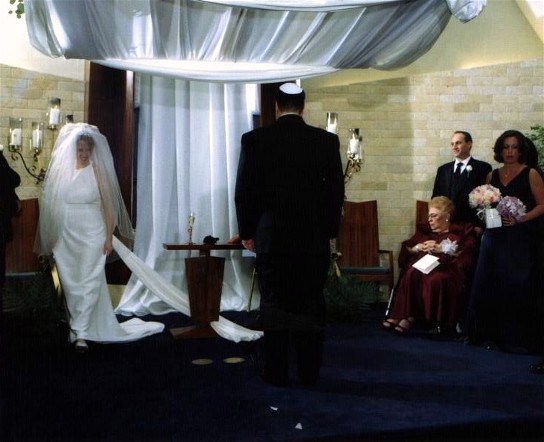
Actually, that looks a lot like MY program. I think I lent her my copy! In that case NO it was definitely NOT an orthodox ceremony! Except I didnt walk 3 times, I walked 7 and my dress got caught and the Rabbi had to help me out by fixing it!!
stephanielyse
Posted:
Member since
Re: Jewish Wedding Programs
Posted by Goldi1021
Actually, that looks a lot like MY program. I think I lent her my copy! In that case NO it was definitely NOT an orthodox ceremony! Except I didnt walk 3 times, I walked 7 and my dress got caught and the Rabbi had to help me out by fixing it!!
You caught me, Leslie! You were my main influence, although, you will notice that I did change quite a few things (besides the 3 circles instead of 7).
So, no it wasn't an orthodox ceremony, but it was a traditional Jewish ceremony.
FallBride05
Posted:
Member since
Re: Jewish Wedding Programs
I still have my template, I will email to you!
ETA: I thought it was neat to use the reference of Abraham and Sarah and their open home/hospitality, as my IL's names are Abraham and Sarah
The Wedding Ceremony
A traditional Jewish wedding is composed of several parts, each one rich in history and meaning. We would like to share the beauty of these ceremonies with you.
The Grooms Tisch: The Wedding begins with the Tenaim, where the stipulations of engagement are agreed upon by the fathers of Michelle, the Kallah (Bride) and Leonard, the Chattan (Groom), and it is signed by two witnesses. At this time, our mothers break a plate to remind us that our joy is incomplete because of the destruction of the Temple in Jerusalem. Next, the Ketubah, (marriage contract) is signed by another two witnesses. In this document, Leonard affirms his marital promise to Michelle.
Kabbalat Panim (Greeting the Bride and Groom) In the Main Hall, Michelle greets her guests. Her friends dance her to the throne since the Chattan and Kallah are considered royalty on their wedding day.
The Badekin (Veiling the Bride) It is custom for the Chattan and Kallah to not see each other for the week leading up to the wedding, so we meet for the first time today at the Badekin Ceremony. Leonard will cover Michelle with her veil. The custom of wearing a veil originates with our matriarch Rebecca who veiled herself upon seeing Isaac for the first time. In order to avoid the possibility that the Chattan may be tricked into marrying the wrong veiled woman, as our patriarch Jacob was with the veiled Leah, Leonard himself places the veil over Michelle.
The Chuppah (The Wedding Canopy) The Chuppah is said to symbolize the home and life we will establish together. In this spirit, the four sides are open to indicate all are welcome in our home and our lives. Some say the openness is to recall Abraham and Sarah’s great hospitality. In addition, we have invited our respective parents and siblings to join us under the Chuppah to symbolize the creation of our new extended family. Once under the Chuppah, Michelle circles Leonard seven times. There are many explanations for this and among the most beautiful interpretations is that the Kallah, when circling her Chattan, is entering into the seven spheres of her beloved’s soul. The number seven is derived from a verse in Hosea in which Hashem betroths himself to Israel with seven promises.
The Rabbi conducting the ceremony now recites two blessings, one over the wine and one over the sanctity of marriage. We then drink the wine. Next is the essence of the ceremony. Michelle accepts a gift, a simple gold ring which symbolizes endlessness and completeness, as two witnesses observe, Leonard places the ring on Michelle’s right forefinger and says, “With this ring, you are sanctified unto me according of the law of Moses and Israel.”
The Ketubah is then read. After that, the Sheva Brachot (Seven Blessings), describing various aspects of rejoicing for the Chattan and Kallah together with praise to Hashem, are recited over a cup of wine. After Michelle and Leonard drink the wine, Leonard breaks a glass to show that even in this time of great joy; we are saddened by the destruction of the Temple. It is customary after the Chattan breaks the glass to shout “Mazel Tov!” to wish the couple good luck.
After the ceremony, we are alone for a few minutes before rejoining our guests for dinner. Thus we have encompassed the three Rabbinic ways of beginning a marriage: contract, acceptance of a gift, and togetherness.
We then rejoin our family and friends for a festive meal to celebrate our marriage. It is also a time to fulfill the unique Mitzvah of rejoicing with the Chattan and Kallah.
Goldi1021
Posted:
Member since
Re: Jewish Wedding Programs
It was my pleasure to help! And to be honest, all of my guests really enjoyed them. I had them done as to not alienate my many non-Jewish guests who hadnt been to a Jewish wedding before. It turns out that most of the Jewish guests, knew the traditions but didn't know what was behind them - so basically they were going through the motions.
Good thing you did 3 circles. Look what happened doing 7:
Everyone was laughing at me - even the Rabbi: And I got caught in the podium!:
Goldi1021
Posted:
Member since
Re: Jewish Wedding Programs
This thread is making me think that I REALLY need to use my shabbat candlesticks and challah plate that DH's grandmother bought for us in hopes that we'd actually demonstrate SOME sort of Jewish identity. Maybe an LIW shabbat dinner? Where we all drive home afterwards? OY VEY!
FallBride05
Posted:
Member since
Re: Jewish Wedding Programs
Posted by Goldi1021
Maybe an LIW shabbat dinner? Where we all drive home afterwards? OY VEY!
How awesome would that be? I have a huge house with lots of space if people were willing to shlep to new jersey
marcandjoanna
Posted:
Member since
Re: Jewish Wedding Programs
Posted by FallBride05
Posted by Goldi1021
Maybe an LIW shabbat dinner? Where we all drive home afterwards? OY VEY!
How awesome would that be? I have a huge house with lots of space if people were willing to shlep to new jersey
I recognize the Rabbi! Thank you for all of the advice - I am really looking forward to making the programs. It seems like a manageable DIY and I think people will appreciate the info.